Tidelines
AI and oil fight for the spotlight
Five years of prices, two engines, and who pays the bill. Oil drives the inflation pressure, AI drives growth expectations, and the bond market can tell them apart.

- AI and oil fought for the spotlight, and both took it: Korea’s market rose 7.8% in a month; Brent futures settled at US$102.25 a barrel on 2 October.
- Right now, petrol drives more of the pressure than food: August petrol prices rose 27.4% in a year; food rose 2.7%.
- Look closer, and tech was almost exempt from the worry: the Nasdaq returned 3.8% in the month, while US banks lost 8.4%, including reinvested dividends.
- Why? The bond sell-off sounds like 2022, but the inflation signal differs: the 10-year real yield was 2.92% on 2 October, while breakeven inflation was 2.36%.
Oil and chip-heavy markets rose; Australia and Hong Kong fell
Price changes in US dollars, 2 September to 2 October 2026. Brent is the front-month futures quote, marked with a dagger.
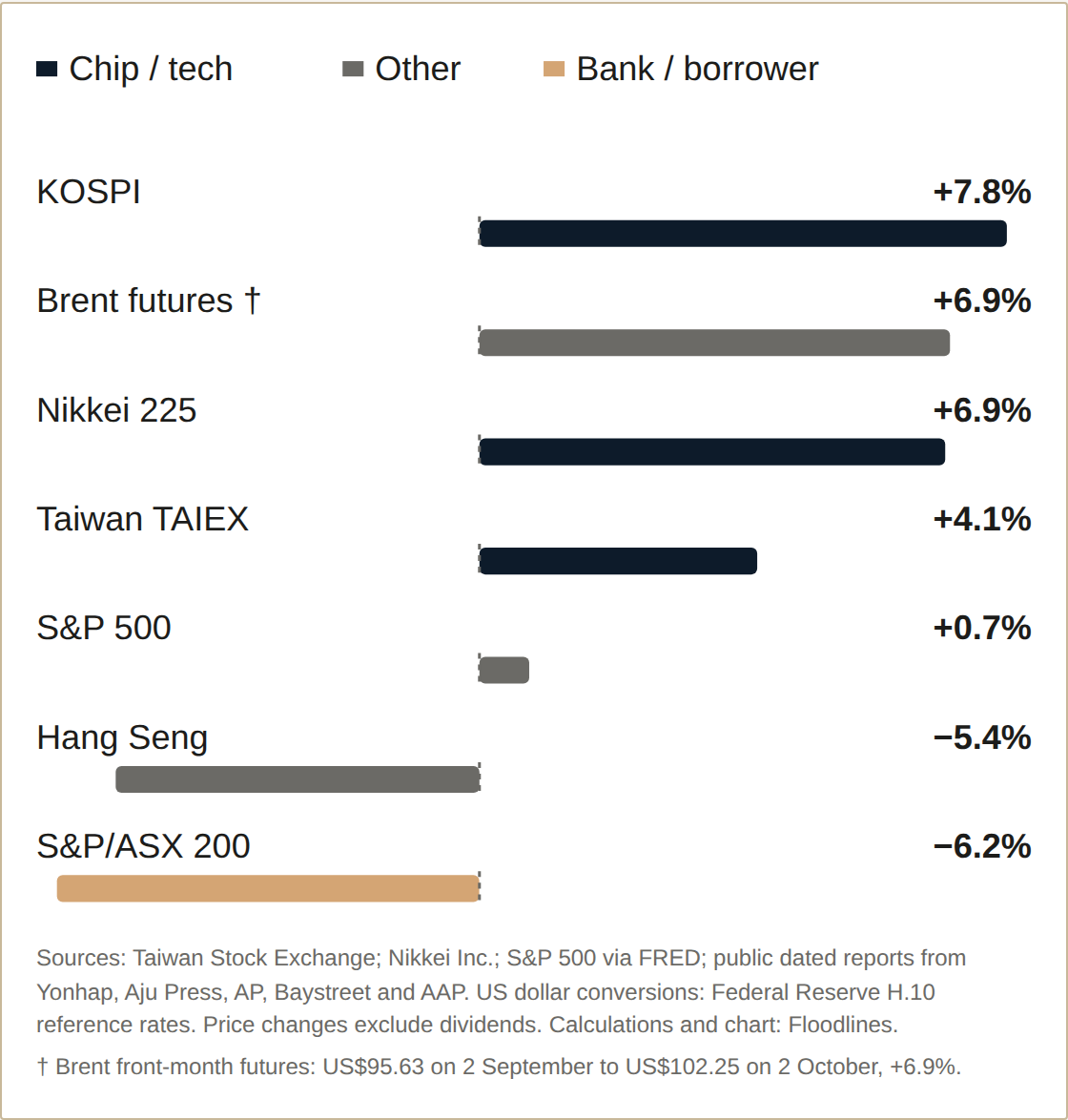
Two engines, one month. Korea, Japan and Taiwan rose in US dollars, while Australia and Hong Kong fell. The chip-heavy markets held up, but this comparison does not isolate chips from every other industry. The stronger US dollar deepened Australia’s fall in US-dollar terms. It also makes imported fuel dearer: Australia imports most of its refined petroleum. Higher oil prices and a weaker Australian dollar add to domestic inflation fears. Oil adds a separate pressure: Brent futures settled at US$102.25 a barrel on 2 October.
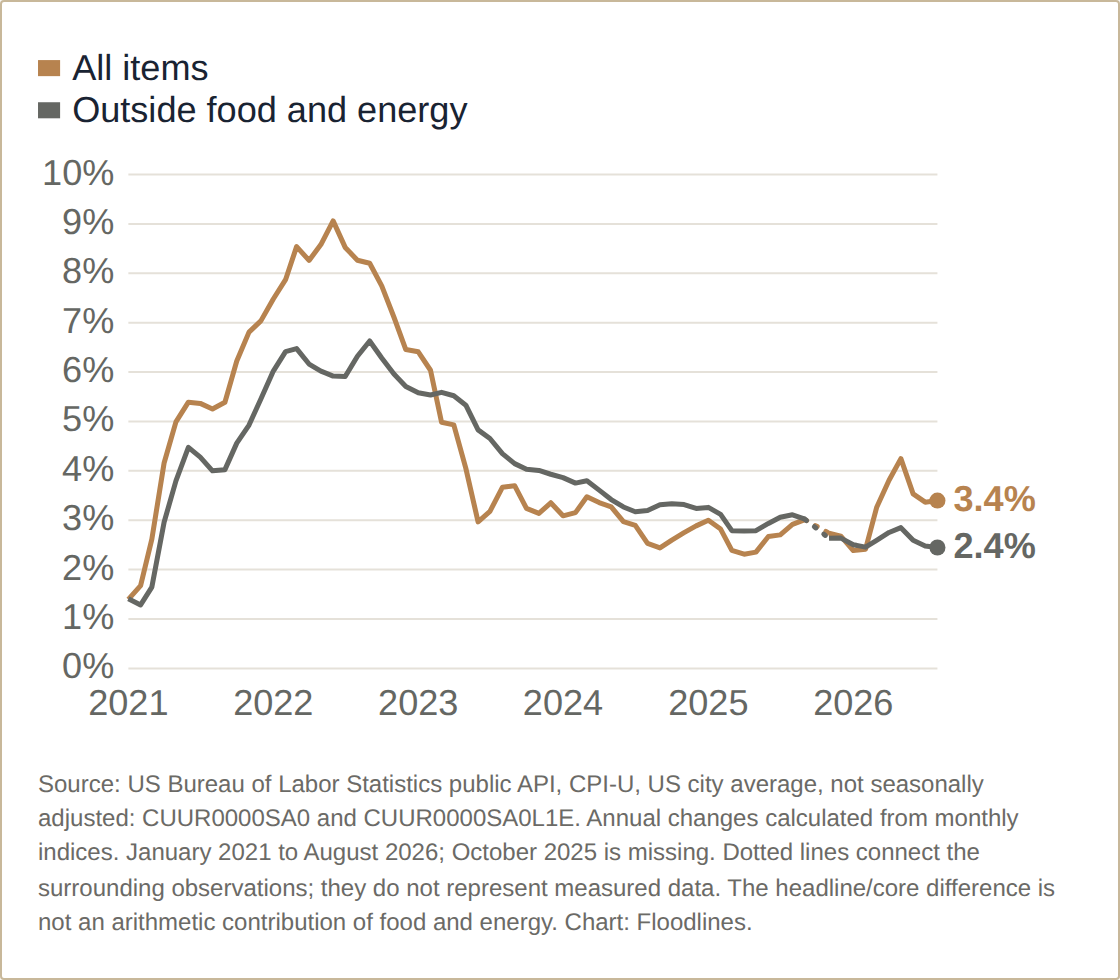
US inflation cooled from 2022, then the energy gap reopened
US CPI, change from a year earlier, monthly from January 2021 to August 2026.
The pump jumps; food prices climb more steadily
Petrol and the food basket, January 2021 = 100.
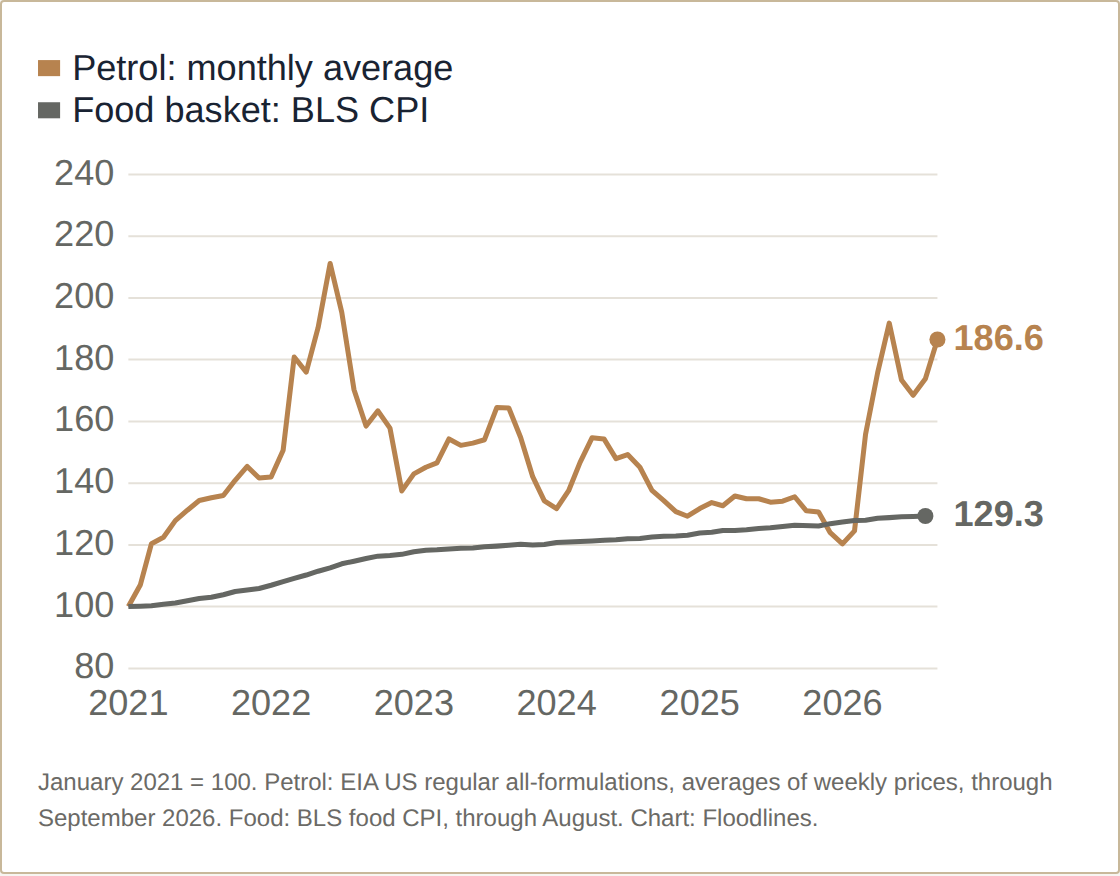
American households feel worse while tech investors feel great. A chip sold to a data centre never reaches a shopping basket. A barrel of oil reaches the pump: regular petrol cost US$4.35 a gallon on 5 October, about 39% above the matching week last year. A Big Mac cost US$6.22 in America in July, 3.5% more than a year earlier, according to The Economist’s Big Mac data. The broader food basket rose 2.7% in the year to August, against petrol’s 27.4%. Petrol accounted for over a third of August’s monthly inflation rise. In September, households expected prices to rise 4.6% over the next year, up from 4.0%, according to the University of Michigan’s consumer survey. The Fed raised rates in September to bring inflation back towards its goal. My reading: the Fed is fighting a petrol crisis, not data centres. Don’t mix them.
Tech rose while US and euro-area banks fell
US dollar total returns, 2 September to 2 October 2026. Dividends reinvested before withholding tax.
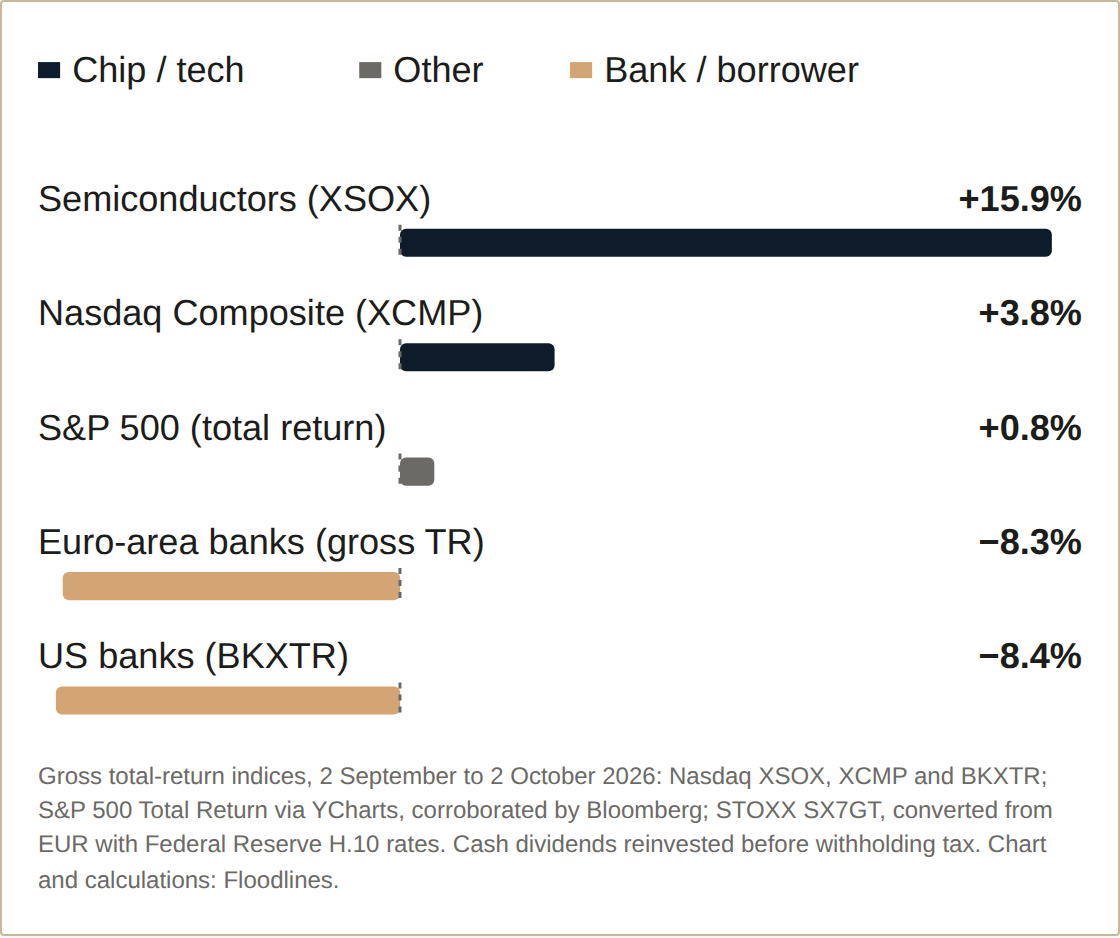
With dividends reinvested, US semiconductors rose 15.9%, the Nasdaq Composite rose 3.8% and US banks fell 8.4%. Euro-area banks also fell on a total-return basis. Higher yields can reduce the value of banks’ bond holdings and raise funding costs, although wider lending margins can offset some of that pressure. Tech held up over this month; that does not make it immune to higher rates.
Real borrowing costs climbed; breakeven inflation stayed near 2.4%
US 10-year real yield and breakeven inflation, weekly last observations from daily Treasury/FRED data, 2 October 2023 to 2 October 2026.
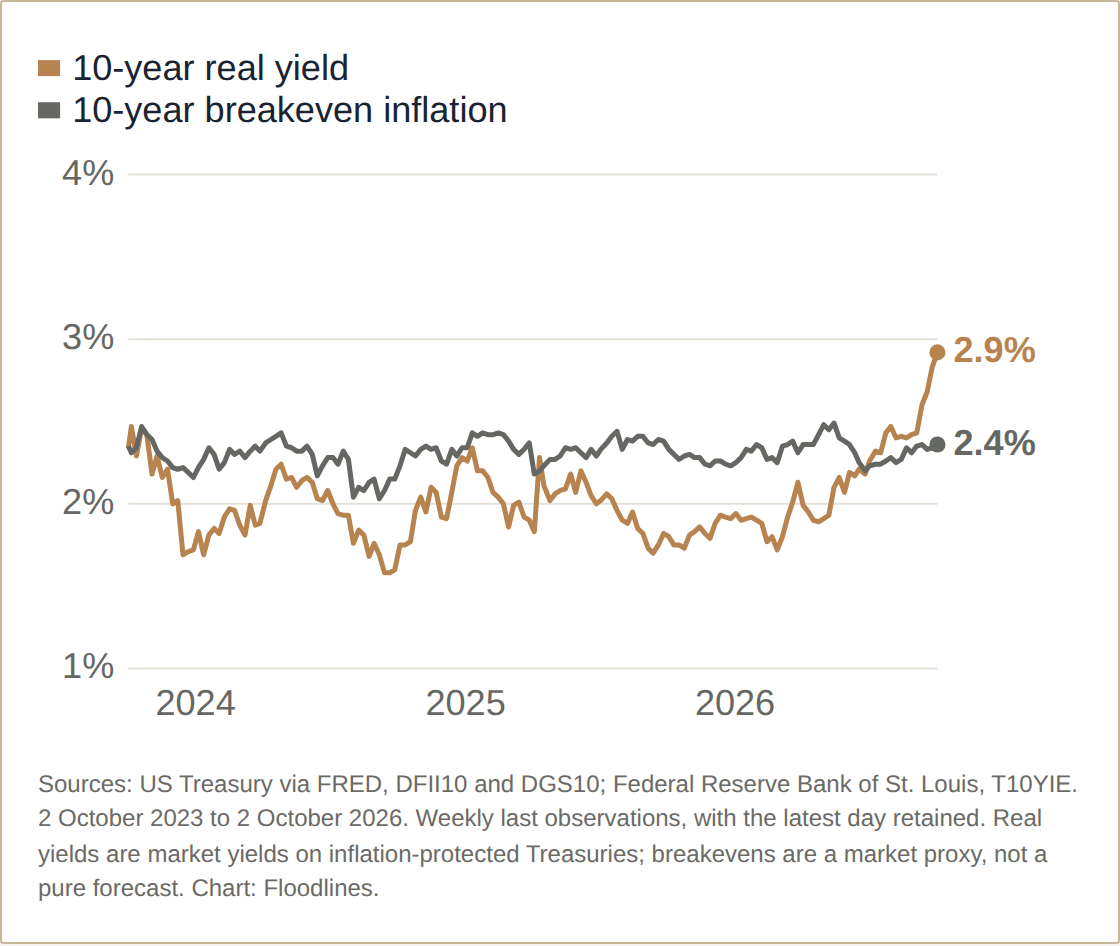
The recent global bond sell-off brings back the bitter taste of 2022. Since the end of 2025, ten-year yields rose 110bps in the US, 103bps in Japan and 87bps in Britain, to 5.28%, 3.10% and 5.33% respectively on 2 October. However, the mix behind the rise is meaningfully different. The early 2022 inflation shock pushed US breakeven inflation above 3%; this year, it added just 11bps to the ten-year yield, while the real yield added 99bps. The real yield is the inflation-adjusted benchmark cost of borrowing. Stronger expected growth raises the return businesses expect from investment, making them willing to compete harder for capital. That demand can push real rates up. My reading: the AI build-out is lifting expected returns and demand for capital, making money dearer even as the inflation signal stays contained.
The tide
Two engines run the global economy: oil presses on living costs, AI on growth expectations. My read: I keep the two engines apart when weighing my next move. Leaning. The bond market can see what the Fed is fighting: real yields have added 99bps this year, breakevens just 11bps. I expect both engines to run in parallel for months, the AI build-out lifting growth while borrowers carry the rate bill. So I’m not reading AI through an inflation lens, and I don’t expect the Fed to be done soon just because borrowing-heavy sectors are already hurting. That changes if breakevens start climbing to meet real yields.
Sources
- Federal Reserve, productivity and real interest rates and RBA, financial conditions and AI investment: stronger expected returns and investment demand can put upward pressure on real rates. Applying this mechanism to the current AI build-out is the author’s thesis.
- Chart 3 total returns: XSOX, XCMP, BKXTR; S&P 500 Total Return; EURO STOXX Banks gross total return, SX7GT. Raw dated Nasdaq responses and independently retrieved STOXX chart history are retained in the source files.
- Australian Energy Statistics, energy trade: imports met 80.8% of refined petroleum consumption in 2024-25. RBA exchange-rate explainer and RBA, higher global energy prices: currency depreciation raises import prices; higher energy prices add to inflation. The reference to inflation fears is the author’s interpretation of this exposure, not a measured attribution of the equity fall.
- BLS public API: CPI-U all items, core, food and gasoline indices. 2020 data retained to calculate annual changes from January 2021. Latest: August 2026.
- BLS August CPI release: petrol +27.4% and food +2.7% over the year; petrol accounts for over a third of the monthly rise.
- EIA petrol prices: regular, all formulations, dollars per US gallon. Five-year history, monthly averages of weekly readings. Latest weekly observation: 5 October 2026.
- The Economist Big Mac data: US local prices only, January 2021 to July 2026; twelve sparse observations. McDonald’s-provided US price since July 2022. No exchange-rate or currency-valuation data used. The third-party-data carve-out is not described as a CC BY grant for these prices.
- Treasury real yields via FRED; FRED breakeven inflation; Treasury nominal yields via FRED: the bond chart spans 2 October 2023 to 2 October 2026; weekly last observations from actual daily history.
- Federal Reserve, 16 September statement: 25bps increase, stated purpose of returning inflation to 2%. The energy emphasis in this article is the author’s reading.
- Bank of England, IUDMNPY: UK 10-year nominal par yield, 4.4664% on 31 December 2025 and 5.3341% on 2 October 2026; +86.77bps, rounded to 87bps. This is a fitted par yield, rather than one benchmark gilt.
- Japan Ministry of Finance, JGB yields: 10-year constant-maturity yield, 2.066% on 30 December 2025 (last observation that year) and 3.097% on 2 October 2026; +103.1bps, rounded to 103bps.
- University of Michigan, September final results: year-ahead household inflation expectations, 4.6% versus 4.0% in August; public headline figures quoted in words only.
- Sources: Taiwan Stock Exchange; Nikkei Inc.; S&P 500 via FRED; public dated reports from Yonhap, Aju Press, AP, Baystreet and AAP. US dollar conversions: Federal Reserve H.10 reference rates. Price changes exclude dividends. Calculations and chart: Floodlines.
- AP, 2 September close: Brent futures US$95.63. Bloomberg CO1 endpoint observations match; the chart uses the unadjusted front-month quote change.
- PFL Petroleum, 2 October market report: Brent futures settlement US$102.25. The 2 September to 2 October quote change is +6.9%, including the November-to-December contract switch.
Currency: non-US indices are converted to US dollars using same-date Federal Reserve H.10 reference rates. Chart 1 excludes dividends; chart 3 reinvests them. Oil is in US dollars. Yields are in percent; changes are in basis points (bps), with 100bps equal to one percentage point.
Index names are trade marks of their owners and identify the indices only. Big Mac is a trade mark of McDonald's, used only to identify the product. No index owner, McDonald's or The Economist sponsors or endorses Floodlines.
Important information
Important. Floodlines publishes independent research and commentary on the economy, markets, industries and supply chains. It is general information only. Floodlines is not licensed to provide financial product advice and does not provide it. Nothing here is a recommendation to buy, hold or sell any financial product. Nothing here has been prepared by reference to any reader’s objectives, financial situation or needs, and Floodlines does not respond to individual questions about personal circumstances, holdings or portfolios. Views are the author’s own as at the date of publication, may change without notice, and may be wrong. Where a piece says how sure the author is of a view, or what would change her mind, that describes her confidence in her own reading of events. It is not an instruction to any reader. Before making any financial decision, obtain advice from a licensed financial adviser and consider the relevant product disclosure statement or offer document. Where a piece reports the author’s past calls, it is a record of her own process, wrong calls included. Past calls are not an indicator of future performance.
Interests. This piece names no company as an investment; the indices and the Brent futures price are shown only as measures of markets. Floodlines receives no payment from any issuer, index owner, underwriter or dealer in connection with anything discussed.
United States readers. Floodlines is a publication of general and regular circulation. It provides impersonal commentary only, does not provide personalised investment advice, does not hold itself out as an investment adviser, and is not registered as an investment adviser with the SEC or any state. Floodlines will not answer questions about your portfolio or circumstances. Floodlines receives no compensation from any issuer, underwriter or dealer in respect of any security discussed.