
Nvidia delivered a record quarter but still sold off almost 20% in three days. Anthropic's IPO scored almost US$1.9 trillion on its launch day, then gave back most of its gain after. Looking beyond AI, stocks, gold, oil and bitcoin are all falling into correction or worse.
So, last week's theme was simple: it looks almost hopeless.
- Last week saw a sell-off across assets, from stocks to gold and bitcoin. Nvidia brought another record earnings but didn't save investors' confidence. Anthropic's IPO was the highlight of the week, but it's dimmed already. In the short term, I struggle to see the scenario where "Captain America" will arrive and turn things around.
- US Treasuries provided protection, especially on Friday, but this time yields fell on growth concerns: first falling inflation expectations, then on Friday falling real yields. As sentiment continues to cool and more signs of growth hollowing show, we could be closer to a policy mistake than we know.
- What could restore investors' confidence in the AI trade? In the past five years, mostly it was a positive catalyst from outside the chip industry. No superhero is needed. This time the biggest overhang is the Fed overtightening, so the rescue might have to come from the same source.
Captain America didn't come this time
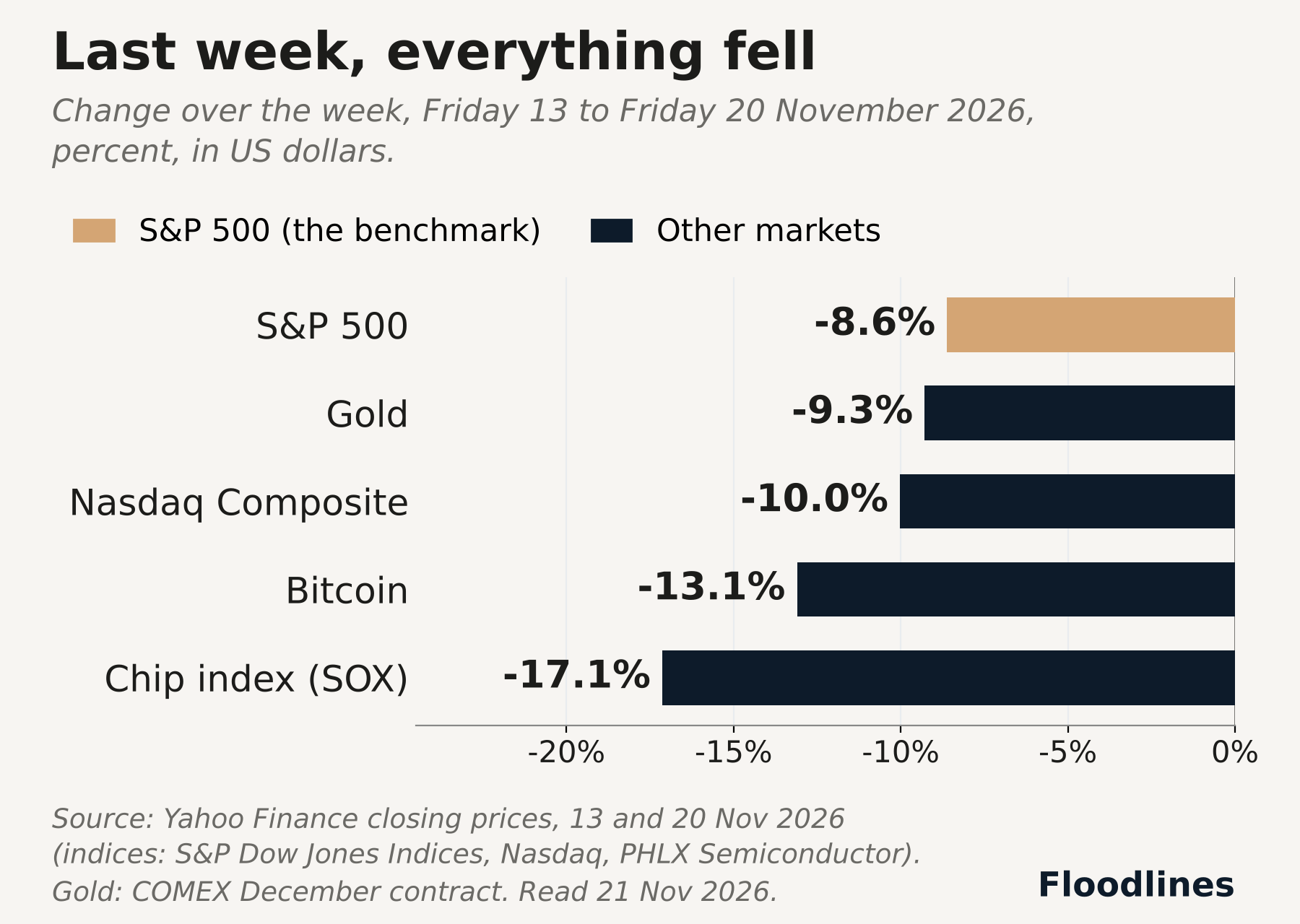
In any Avengers movie, the superhero always arrives just in time to save that child before the car hits him or her. Confession: yes, I am a Marvel fan. However, that's just a movie, not US markets in real life last week: the S&P 500 fell 8.6%, the Nasdaq fell 10.0% (the chip index, SOX, declined 17.1%), gold slumped 9.3% and bitcoin fell 13.1%.
Change over the week, Friday 13 to Friday 20 November 2026, %, in US dollars. Source: Yahoo Finance closes; Floodlines calculation.
Nvidia delivered a record quarter with a clean beat on revenue, earnings per share (EPS) and margin, and Colette Kress (Nvidia's interim CEO) reassured investors about the firm's revenue growth and investment discipline around neoclouds. After the results the company's stock traded up by as much as 5%, but closed down 2.9% the next day, and was down 19.3% within three days, as investors lost hope that Jensen Huang would return as the CEO.
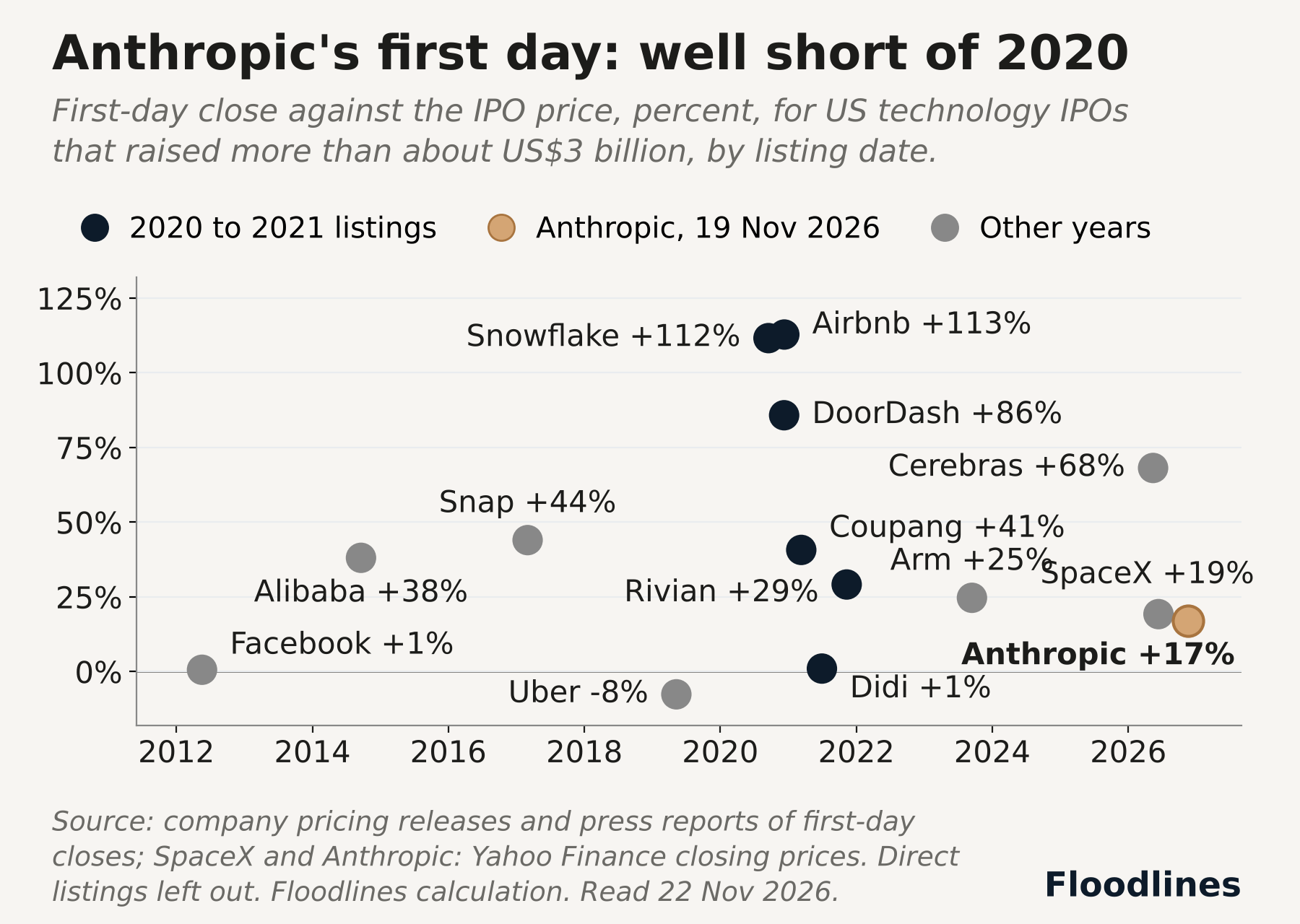
Similarly, Anthropic's IPO* was rewarded on the first day, closing 17% higher than its offer price (2020's biggest debuts closed their first day up 86% to 113%), but fell 8.5% on its second day. The rest of the market also did not join the IPO rally. Why?
First-day close against the IPO price, %, US technology IPOs that raised more than about US$3 billion, by listing date. Facebook (now Meta). Source: IPO prices from final prospectuses (SEC EDGAR); first-day closes, Yahoo Finance; Floodlines calculation.
Against a backdrop of fear: hollowing growth, elevated inflation, falling investor confidence and geopolitical uncertainty, we need to face the reality that chances are limited for any single high-stakes "good news" to turn things around, at least for the near term.
My reading: Fear has become the undertone of the market. In the short term, I struggle to see the scenario where "Captain America" will arrive and turn things around. I am bracing myself for higher volatility and correlations across risk assets heading towards one.
Closer to a policy mistake than we know
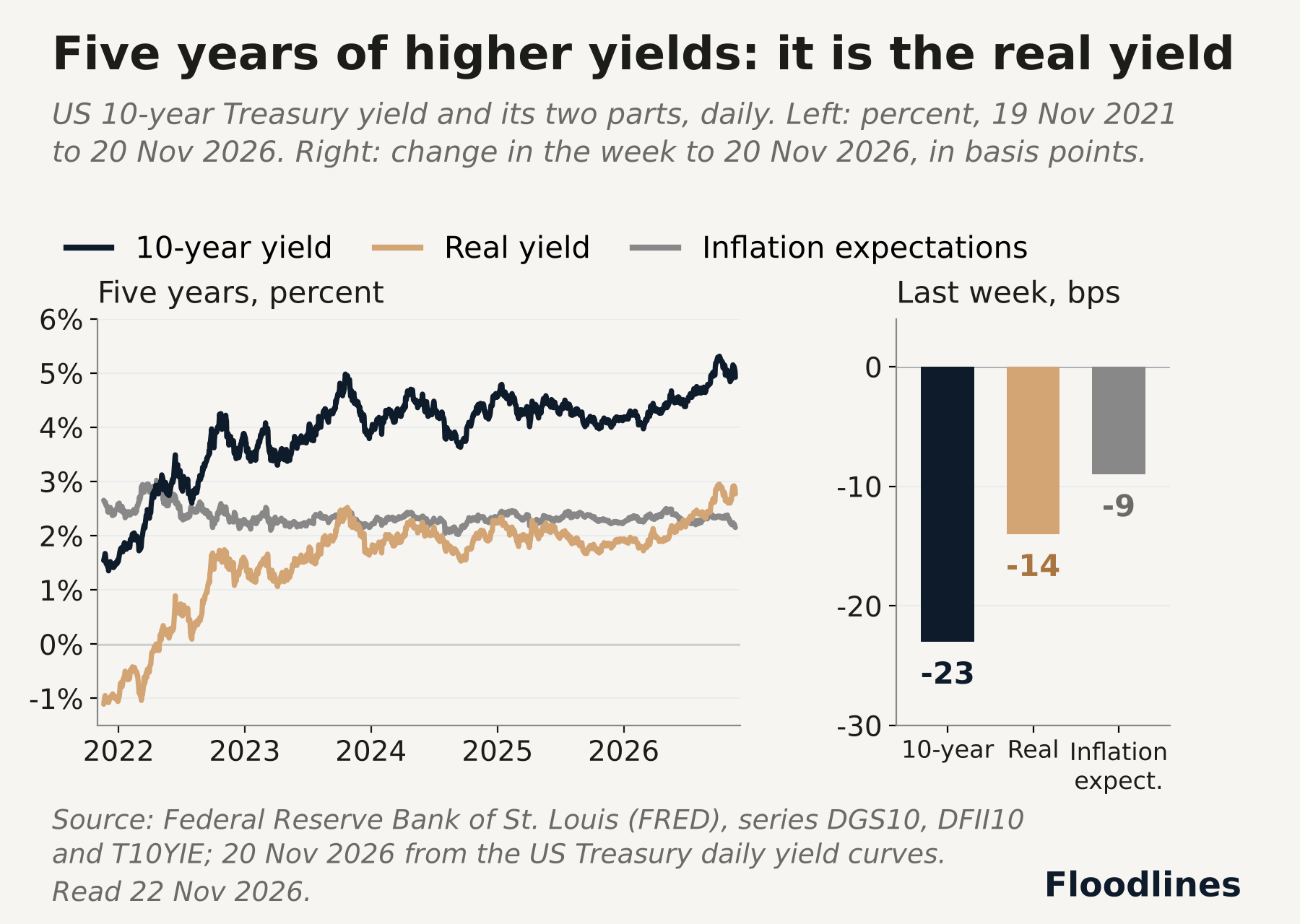
US Treasuries provided protection last week: as stocks sold off, the 10-year yield fell from 5.15% to 4.92%. Zoom in on what drove it: inflation expectations fell first, as the growth concern grows, then on Friday, real yields fell too on rising expectations of the Fed to stop sooner.
US 10-year Treasury yield and its two parts, daily: %, 19 November 2021 to 20 November 2026; change in the week to 20 November 2026, bps. Source: Federal Reserve Board via FRED (DGS10, DFII10, T10YIE).
Yet the Fed seems still set on a December hike, about 90% probability priced by the futures market, with one more by March 2027. It sees the growth hollowing but hikes anyway, likely to avoid a replay of 2021's policy mistake of hiking too late. It even counts the AI build-out as one of the causes of inflation in Vice Chair Jefferson's latest speech, so it is hiking against the very trade that is supporting growth and showing cracks now.
The bond market and the Fed are not in full agreement. One of them could be making a mistake. In this case, I think it is the Fed. Why?
Because the market may not be strong enough to take it this time. Equities are in a correction. Households are under the pump as real wages have been falling since April. Top AI spenders are losing market cap fast while, together, spending more cash than they bring in. In this environment, that could become a trust issue.
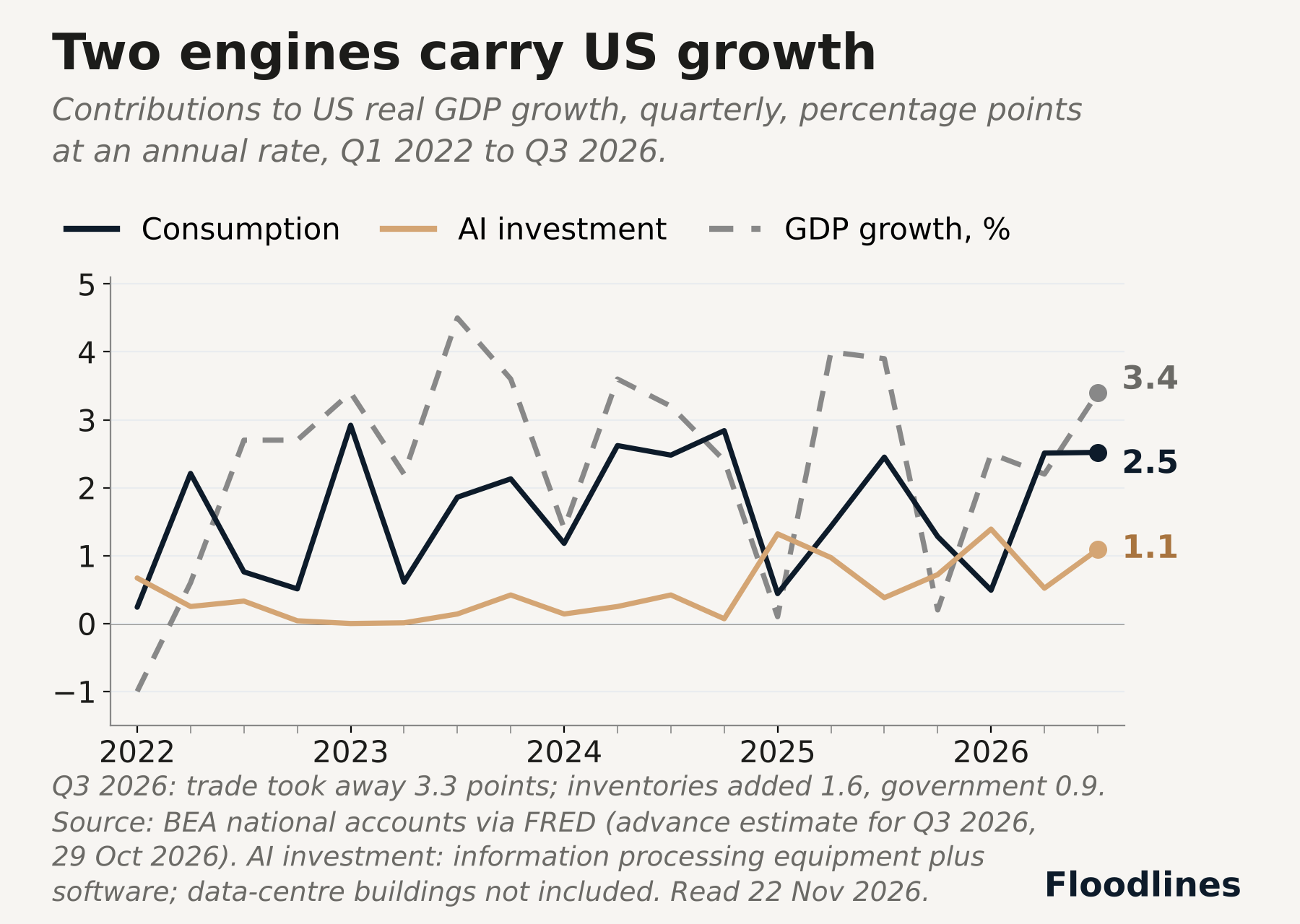
The main engines of US growth, AI and consumption could turn down quickly.
Contributions to US real GDP growth, quarterly, percentage points at an annual rate, Q1 2022 to Q3 2026. Source: US Bureau of Economic Analysis; 'AI investment' is Floodlines' grouping.
Call me a pessimist but I think we could be closer than we know to another policy mistake: not hiking too late this time but overtightening. I just don't know if we can take two within 5 years. Look back to 1972 to 1974: the Fed eased rates to 3.3% first while inflation built, then pushed them to almost 13% into a recession. History said no.
My reading: Bonds provided protection last week, but only because growth is hollowing, and the Fed can take that shield away by hiking more aggressively. The market and the Fed disagree, and I think we could be closer to another policy mistake than we think. The yield trap and a downturn can both happen, just in a different order: the trap could come first, followed by the economic downturn.
No superhero needed
What could restore investors' confidence in the AI trade? It's a tough question, so I went back through every AI sell-off of the past 5 years to see what did.
Mostly, it was a positive catalyst from outside the chip industry: a tariff pause, a ceasefire, bond yields peaking, or the big cloud companies keeping their wallets open. In five years no star has ended a sell-off; in fact, the two star moments, DeepSeek and Jensen Huang's exit, started one and deepened another.
US chip index, cumulative return since 19 November 2021, daily close, to 20 November 2026, log scale. Source: PHLX Semiconductor Sector Index, Yahoo Finance closes; returns by Floodlines.
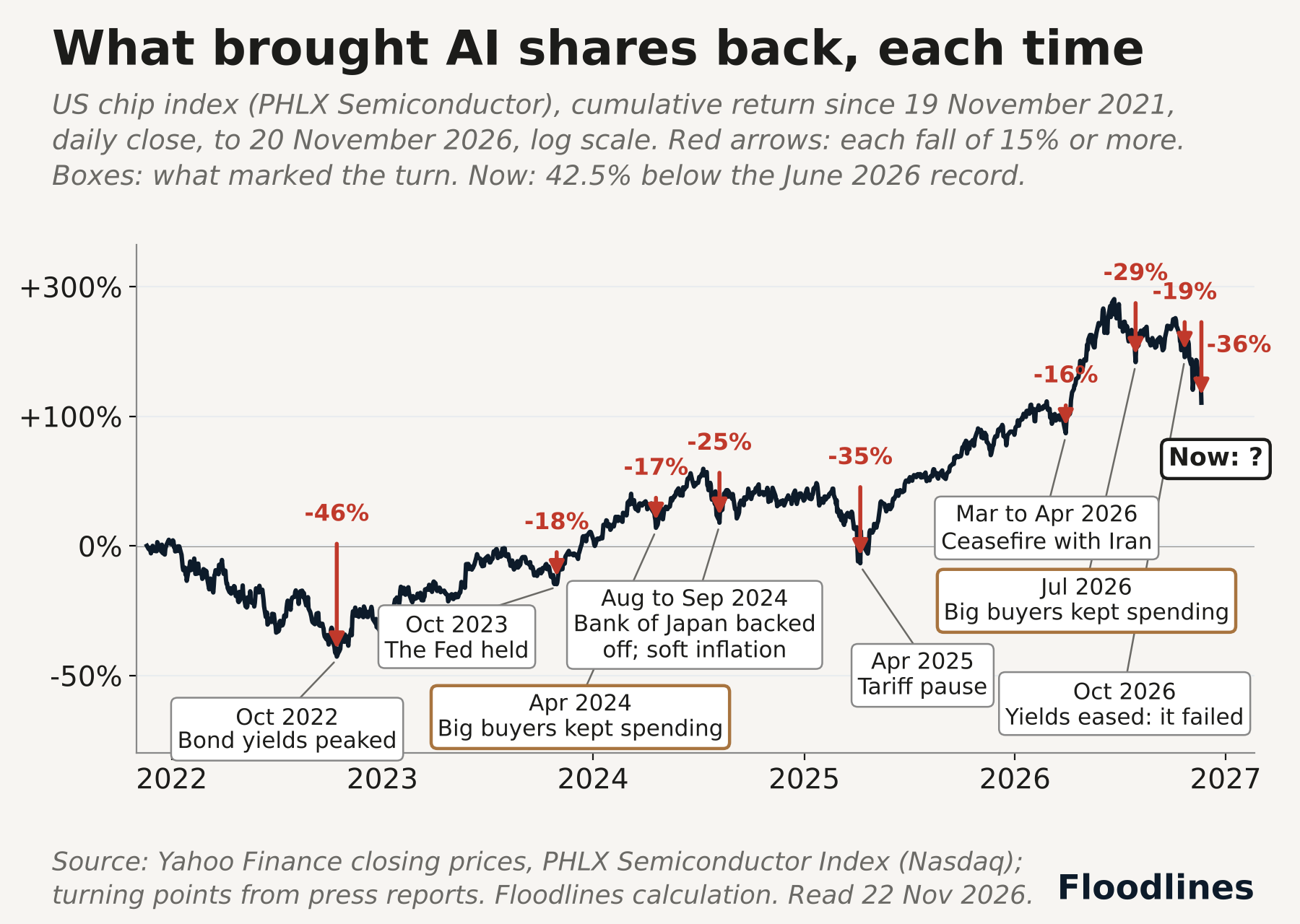
This time looks like 2022 in one way. The biggest overhang is the Fed overtightening, so the rescue might have to come from the same source. The Fed could make it worse through aggressive tightening. Historically, chip sell-offs often recover quickly, typically in about 2 months. The slowest, 14 months, was 2022, the one time the Fed was hiking aggressively into it.
That lesson makes it even more important that the Fed does not make another policy mistake, with the next earnings season due in late January 2027.
My reading: The key to a chip recovery is not complex: just don't put a persistent block on it. No superhero is needed; some good outside news that relieves the macro overhang will do. This time the biggest overhang is the Fed overtightening, so the rescue might have to come from the same source.
The tide
So, is it hopeless? Almost. No superhero is coming, and none is needed. The way out is less movie-like: the macro overhang easing, step by step, and no material policy mistake on the way. For my own money, I am bracing myself for cross-asset volatility and reading every word the Fed says. The bond market and the Fed disagree, and the wider the gap, the less I think about buying the dip in equities. I want to see the Fed move towards the market, not the other way around. What would change my mind: chips stop falling while the Fed is still hiking, as in October 2022.
Two dates will give me more information: the Fed's statement and press conference on 9 December (US time), and late January to early February next year, when it meets again and the big AI spenders report.
This is how I am thinking about it, not advice about what you should do.
* Disclosure: Floodlines pays to use Anthropic's Claude in its research; no other relationship with Anthropic or its underwriters. I hold no Anthropic shares and did not apply in the IPO.
General information only, not financial advice. It does not consider your objectives, financial situation or needs; seek advice from a licensed adviser.
The week as a test
| When (Sydney) | What | What it decides |
|---|---|---|
| Wed 25 Nov, 11:30 | Australia CPI (October), ABS | Elevated inflation, outside the US |
| Thu 26 Nov, 00:30 (Wed 25 Nov, 08:30 US Eastern) | US core PCE (October) and US GDP, Q3 second estimate | Section 2: the inflation the Fed is hiking against, and whether 3.4% growth holds |
| Fri 27 to Sat 28 Nov | US Thanksgiving | Thin trade |
| Tue 8 Dec, 14:30 | RBA decision | Australia's rates path |
| Thu 10 Dec, 06:00 (Wed 9 Dec US) | Fed decision, statement and press conference | Sections 2 and 3: does the Fed move towards the market? |
| Just beyond: 26 to 27 Jan 2027 (US) | Fed meeting | Sections 2 and 3 |
| Just beyond: late January to early February 2027, dates not set | Big AI spenders report | Section 3: are the big buyers still spending? |
SourcesShow all 19Hide
- Weekly moves: Yahoo Finance closes for the S&P 500, the Nasdaq Composite, the PHLX Semiconductor Sector Index, gold (COMEX December contract) and bitcoin, 13 and 20 November 2026, read 21 November 2026; Floodlines calculation.
- Nvidia results: "NVIDIA Announces Financial Results for Third Quarter Fiscal 2027", November 2026.
- Nvidia share price: Yahoo Finance closes, three sessions to 20 November 2026 (155.46 to 125.53); Floodlines calculation.
- Nvidia's board: The Korea Times, "Nvidia chairman says board does not intend to reinstate Jensen Huang as CEO", 18 November 2026.
- Anthropic listing: Anthropic, final prospectus (424B4), 19 November 2026 (IPO price US$83); first-day and second-day closes from Yahoo Finance; value at the first-day high on a fully diluted share count, Floodlines calculation.
- Chart 1: Yahoo Finance closes; Floodlines calculation.
- Chart 2: IPO prices from final prospectuses (SEC EDGAR); first-day closes, Yahoo Finance; Floodlines calculation. Facebook is now Meta.
- Treasury yields: US Department of the Treasury, Daily Treasury Par Yield Curve Rates and Daily Treasury Par Real Yield Curve Rates, 2026, read 22 November 2026.
- Chart 3: Federal Reserve Board via FRED (DGS10, DFII10, T10YIE), read 22 November 2026.
- December hike probability: December federal funds futures (CBOT), via Yahoo Finance, 20 November 2026; Floodlines calculation.
- Fed speech: Vice Chair Philip N. Jefferson, Board of Governors of the Federal Reserve System, 19 November 2026.
- Real wages: US Bureau of Labor Statistics, Real Earnings, October 2026, 10 November 2026.
- AI spenders' cash: company quarterly reports and filings (SEC EDGAR); Floodlines calculation.
- Chart 4: US Bureau of Economic Analysis, national accounts, via FRED (advance estimate for Q3 2026, 29 October 2026); 'AI investment' is Floodlines' grouping.
- 1972 to 1974: effective federal funds rate, Federal Reserve Board via FRED (FEDFUNDS); NBER business cycle dates.
- Chart 5 and the sell-offs: PHLX Semiconductor Sector Index, Yahoo Finance closes; returns by Floodlines; turning points from press reports, including Reuters, 19 October 2026. Read 22 November 2026.
- Floodlines, Tidelines, "Don't Get Comfortable", 16 November 2026.
- The week as a test: release calendars of the Federal Reserve, the RBA, the Australian Bureau of Statistics and the BEA; times are Sydney (AEDT).
- Cover: Floodlines (illustration).
Currency: share, index, gold and bitcoin moves are price only (no dividends), in US dollars. Yields are in percent; changes are in basis points (bps), with 100bps equal to one percentage point.
Company, index and benchmark names are trade marks of their owners and are used only to identify the companies, indices and benchmarks concerned. That includes the S&P 500 index (S&P Dow Jones Indices) and the Nasdaq Composite Index and PHLX Semiconductor Sector Index (Nasdaq, Inc.). Captain America, Avengers and Marvel are trade marks of Marvel Characters, Inc.; Floodlines is not affiliated with or endorsed by Marvel or Disney. No company, index owner, benchmark administrator or data publisher named here sponsors or endorses Floodlines.
Important information
Show full termsHide full terms
Important. Floodlines publishes independent research and commentary on the economy, markets, industries and supply chains. It is general information only. Floodlines is not licensed to provide financial product advice and does not provide it. Nothing here is a recommendation to buy, hold or sell any financial product. Nothing here has been prepared by reference to any reader’s objectives, financial situation or needs, and Floodlines does not respond to individual questions about personal circumstances, holdings or portfolios. Views are the author’s own as at the date of publication, may change without notice, and may be wrong. Where a piece says how sure the author is of a view, or what would change her mind, that describes her confidence in her own reading of events. It is not an instruction to any reader. Where the author says what she is doing, or is comfortable doing, with her own money, that describes her own decision in her own circumstances. It is not a recommendation that any reader do the same. Before making any financial decision, obtain advice from a licensed financial adviser and consider the relevant product disclosure statement or offer document. Where a piece reports the author’s past calls, it is a record of her own process, wrong calls included. Past calls are not an indicator of future performance.
Disclosure. Floodlines pays to use Anthropic's Claude in its research; no other relationship with Anthropic or its underwriters. I hold no Anthropic shares and did not apply in the IPO.
Interests. No company in this piece is discussed as an investment. Nvidia is named for its results, share move and leadership; Anthropic for its listing; DeepSeek as a past market event; the companies on chart 2 for their first-day moves. The author holds no position in any of them (shares, bonds, options or other securities, directly or through an account she directs), has bought no Anthropic shares and did not apply in the IPO. She holds no fund tracking these indices, technology, AI or the broad market; no options or futures on them; no US Treasuries, government bond, money market or cash fund; no rate futures or options; no bitcoin, gold or oil product. Floodlines pays Anthropic for Claude and receives nothing else from it or from any issuer, index owner, underwriter or dealer.
United States readers. Floodlines is a publication of general and regular circulation. It provides impersonal commentary only, does not provide personalised investment advice, does not hold itself out as an investment adviser, and is not registered as an investment adviser with the SEC or any state. Floodlines will not answer questions about your portfolio or circumstances. Floodlines receives no compensation from any issuer, underwriter or dealer in respect of any security discussed.